Spaceship. Lifeboat. Crew
I am not particularly interested in outer space.
There, I said it, and it feels like a confession. For someone my age—Gen X, raised on rockets and Reagan and the promise of “the final frontier”—I’m aware this borders on heresy. We were in sixth grade when Christa McAuliffe boarded the Challenger and never came back. People my age remember exactly where they were when they watched it happen. My husband does. I don’t.
It’s not that I’m cold. It’s just that space—the vastness, the other planets, the possibility of life elsewhere—has never hooked me. You could offer me a free ticket to Mars, and I would need to know whether there's flora and fauna to touch and smell, and whether there’s a decent place to shower. And yet. Lately, I’ve been unable to look away.
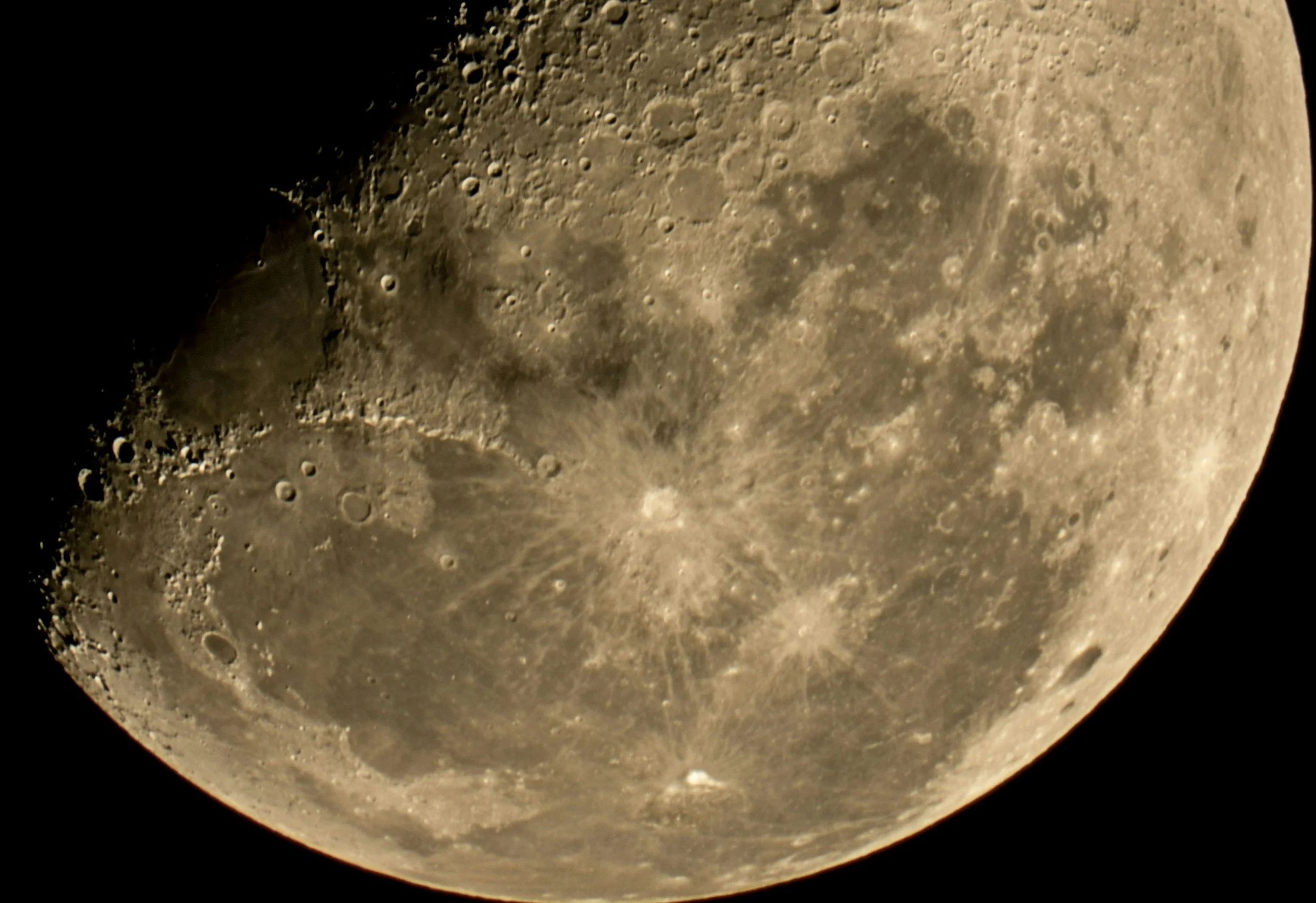
The pictures of the moon are wondrous, but the people who have been there are even more so. (Aside from the fact that they are the crème de la crème of NASA and were all born in the 1970s—and what that tells you about peak brain function—I am thrilled to know this.)
Astronaut Reid Wiseman said that before launch, it feels like the greatest dream on Earth. And then you’re out there, and all you want is to come back. You’re 200,000 miles away, and suddenly what matters is your family, your friends, your ordinary life.
Astronaut Christina Koch said, “A crew is inescapably, beautifully, dutifully linked. Planet Earth—you are a crew.”
Astronaut Victor Glover looked back at Earth and said, essentially: " You think what we’re doing is special because we’re in a spaceship. But you’re in a spaceship too. It’s called Earth.” And what struck him most wasn’t the Earth itself, but the blackness around it. All that nothing. And then, this: a lifeboat, hanging there.
It’s a strange thing, to need that kind of distance to see what’s always been true. I have never been 200,000 miles from Earth. But I have known what it feels like to be unmoored.
All of this reminded me of two stories, so here goes:
Atlanta to Melbourne, Australia, via San Francisco. Twenty-four hours of travel, plus the existential crisis of losing an entire day of your life somewhere over the Pacific Ocean. You leave on Sunday. You arrive on Tuesday. Unless, of course, you are me. Then you arrive on Wednesday.
We took off from Atlanta at 7 p.m., and almost immediately there was a medical emergency on the plane. Nothing life-threatening, thankfully, but enough to derail our carefully constructed itinerary. By the time we landed in San Francisco, our connecting flight to Melbourne was out of reach.
There is a particular kind of cardio reserved for moments like this—running through an airport with your son, and a few other stragglers, your shoes half untied, your dignity fully untied, chasing a plane that you can actually see through the glass.
We made it to the gate. The plane was there, but we were not going to be on it.
“Nothing doing,” the airline agent told us, in a tone that suggested she had said this before and would say it again. One of us collapsed onto the carpeted floor. (It wasn't me. I am a good runner.) It’s unclear whether this was exhaustion or protest. Possibly both.
I was disappointed. I had imagined the long flight from San Francisco with my extended family on that now-barred-from-us flight—fourteen hours of forced togetherness, which at this stage of life counts as quality time. But I was also, if I’m being honest, a little giddy.
An unexpected night in San Francisco with my oldest child. A drive through the hills. A visit with a friend. Two showers. You don’t understand the value of a second shower until you are facing a fourteen-hour flight.
By the time I finally arrived in Melbourne—late, disoriented, and seated at a manicure just hours before a family wedding—I felt like “A plastic bag drifting through the wind.”
There is a word in Torah: Ayeka. God asks Adam, “Where are you?” It is not a question about geography; it is a question about presence.
Sitting there in that salon, I could not have answered it. I did not know where I was in time, in space, in my own body. I needed grounding, and quickly, because in a few hours I was expected to be a coherent, joyful participant in my nephew's wedding.
I picked two nearly identical nail polish colors, because this felt like the level of decision-making I was capable of. The woman behind me asked if she could see one; I absentmindedly handed it to her. “Perfect,” she said.
She sat down next to me. I could tell she wanted to talk, which was unfortunate because I did not. What could I possibly gain from a conversation with a stranger in Australia—someone I would never see again? Thankfully, she did not ask for my permission.
“Are you from the U.S.?”
“Yes. Atlanta.”
“Oh, my stepdaughter lives there.”
You know how conversations usually go. You nod politely. You say, “Oh nice.” You return to your phone. But something in me—maybe desperation, maybe boredom—leaned in. “Where in Atlanta?”
“Near a park… I can’t remember the name.”
“Piedmont Park?”
“Yes! That’s it!”
This is the moment where a normal person says, “Small world,” and leaves it at that. We did not leave it at that.
“My stepdaughter works at a doll shop,” she continued. There is only one appropriate response to this, which is: “Of course she does.”
But instead, I said, “blabla dolls?”
“Yes!”
Now I was sitting up.
“Those were the first gifts waiting for me when I brought my twins home from the hospital,” I said, becoming nostalgic. “We used to take our preschoolers to their shop.”
She stared at me. I stared at her. This was no longer a conversation; it was a rope tethering me to the big, bulky massage chair hovering beneath me.
She mentioned she had just moved to this neighborhood in Melbourne. That she had never been to this salon before. That she almost didn’t ask me about the nail polish.
Meanwhile, I was scrolling frantically through my phone, pulling up an old Instagram post—photos from a visit to that exact doll shop. “Here!” I showed her. Her stepdaughter’s workplace and her stepdaughter’s coworkers. On my phone. On the other side of the world.
A woman I had never met, who almost didn’t speak to me, who I almost ignored, sat next to me at random, at the exact moment I felt most unmoored, and handed me back to myself.
Ayeka. Here you are.
You would think one story like that would be enough. I have another:
We landed in New Jersey last month for a family wedding, the kind of wedding that requires a flowchart to explain the relationships. My brother’s son-in-law is my son-in-law’s brother. My daughter’s sister-in-law is also her first cousin. No one is related by blood, which somehow makes it more complicated, not less.
On the way, we stopped in Evergreen Kosher Market. If you have never been there, imagine a supermarket that is also a flower shop, a pizza shop, a café, and a small city. We walked into this fully kosher world, and I had an immediate and surprising thought: I feel more at home in my local Trader Joe’s than I do here.
It was disorienting. Here I was, surrounded by people who looked like me, shared my language, my rhythms, my references—and I felt completely outside of it.
There is a particular loneliness when you see the “we of me”, and not feel part of it. When you are amongst the tribe and do not feel claimed by it.
After a few minutes—and a necessary coffee—I had a different thought: If I speak to one person, we will find a connection. It felt almost like a challenge.
The next day, I walked into a gift shop in the Evergreen complex and started talking to the shopkeeper. Not Chabad. Plain frum. Where are you from? Atlanta. Oh, we know someone in Atlanta—Rabbi Lerman.
This shopkeeper is related to his wife, oh, and my daughter-in-law is her niece. They are cousins. Of course they were. We kept going.
Last names were exchanged. Connections multiplied. At some point, I realized I had heard that last name before—from a childhood friend (not chabad), from a summer camp in the Catskills, from a completely different version of my life.
I texted her. She confirmed it. She added a layer; her daughter was also married into this family, which I just learned is related to my daughter-in-law. What even?
The man standing in front of me, in a store I had never entered before, in a town I do not live in, was now connected to me through multiple threads—family, memory, shared history.
One conversation. As I suspected, that was all it took.
Up in space, they look back and see one thing: Not countries or communities. Not insiders or outsiders. Just a lot of blackness and a ball called Earth.
Down here, it doesn’t always feel that way. Down here, we miss flights. We lose days. We sit in nail salons feeling like ghosts in our own lives. We walk into rooms full of people who should feel like ours and feel like strangers. Down here, we drift.
And yet, again and again, something interrupts the drift: A question. A conversation. A name. A thread—until suddenly, the Ayeka reveals itself.
Let us not need 200,000 miles of distance to see that we are all connected—that we are not floating, even when it feels that way. We are—inescapably, beautifully, and dutifully—linked.